
Should I repair or replace my damaged roof?
If you identify an issue with your roof, restoring it as efficiently and effectively as possible will naturally be a top priority. But alongside this, the cost and time required for the repair job will also be key points that you’ll want answered.
It’s important to note that roof damage doesn’t always require a full roof replacement.
In fact, in many cases, targeted repair work can fully restore the integrity of your roof. What’s more, precise repairs can achieve these results more quickly and cost-effectively than a full roof replacement. But, this is not always the best approach to take.
For many homeowners, the challenge is to determine when it is best to repair the roof, and when they should prioritise a full roof replacement.
In this guide, the team at B&S Roofing have outlined the most common types of roof damage, how these issues can affect the long-term condition of your property, and whether or not a roof repair or a full roof replacement would be the best course of action.
The most common types of roof damage
First, let’s go through the most common types of roof damage that you may encounter.
Leaks
Leaks are a common and obvious indicator of a roofing issue. Leaks can be caused by a number of factors, including damaged flashing, worn seals, slipped tiles or general deterioration.
If the leak is small and localised, then it can usually be addressed with a roof repair (especially if the roof’s underlying structure is still sound).
However, if you see multiple leaks or water ingress (particularly if the issue has been left untreated for a long period of time), then this may be a sign of deeper issues (such as a rotting underlay, saturated insulation or structural decay, for example). In these instances, it is advised that you invest in replacing the affected section.
Slipped or fallen tiles
If a tile has slipped or is missing, then this exposes the roof layer beneath. If unaddressed, this can quickly lead to further damage.
Often, this is a localised issue. So, if only a few roof tiles are affected (and the rest of the roof tiles are present and in good condition), then in most cases this can be resolved with a simple repair job.
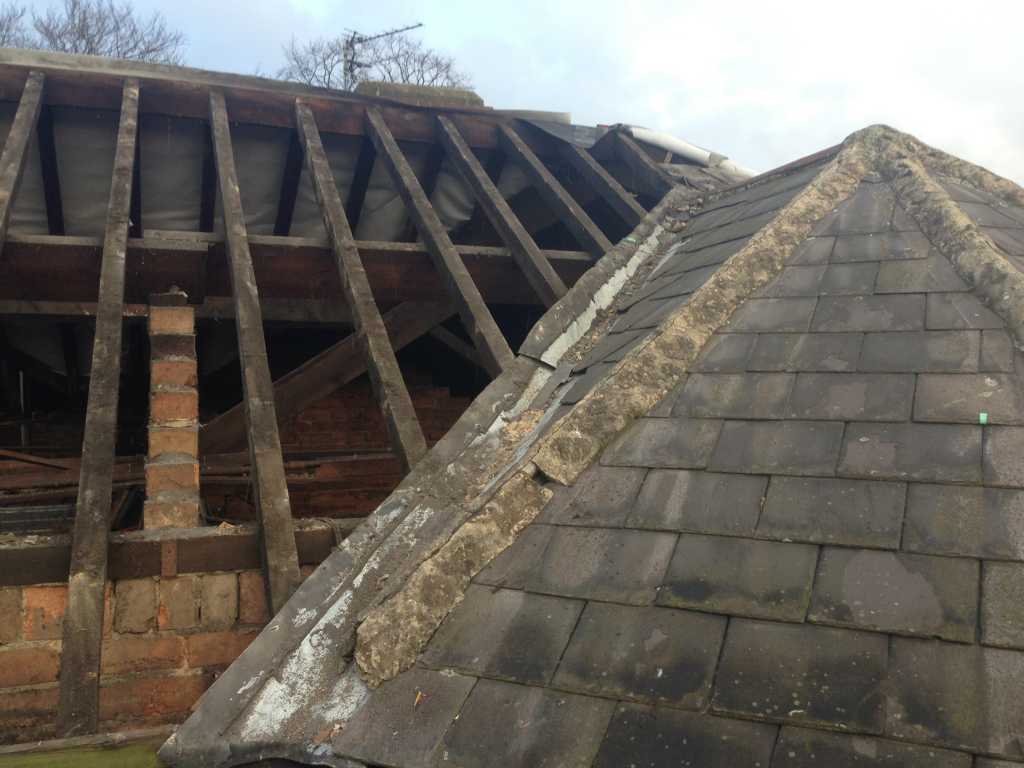
But, if you notice that your tiles are frequently slipping, breaking or falling off, then this is a sign of a more significant failure. It could be that your roof system is ageing, or that its fixings are failing. As a result, it could be that replacing the roof presents a more cost-effective solution in the long term.
Moss and mould
Another issue that you may notice arising with your roof is the growth of moss and mould.
Although moss isn’t automatically an indicator that your roof needs to be replaced, heavy moss growth can lead to long-term high moisture exposure for your roof. This can quickly lead to the roof weakening, which would then necessitate a replacement.
Similarly, mould growth is often an indicator of persistent damp in the roof system.
If the moss is only surface-level or hasn’t been present for a long time (and the roof beneath is in good condition) then the issue can usually be resolved by cleaning the roof and applying a moss treatment.
But, if the moss has caused long-term damage to the roof (e.g. making the tiles porous or brittle), or if investigating the mould makes you aware of deeper moisture damage, then it’s best to replace the affected area.
Cracks (Flat roofs)
Cracks are an issue that is specific to flat roofs, particularly older felt roofs.
These roof types are susceptible to cracking, particularly after exposure to extreme weather or significant temperature fluctuations.
In the case of small cracks, these can usually be addressed by patching or resealing the roof.
However, if the roof has experienced extensive cracking, blistering or pooling water, then this indicates that the roof membrane needs to be replaced.
Roof reaching the end of its lifespan
Even if you can’t see any signs of damage, an older roof is inherently weaker and at greater risk of damage.
Typically, a pitched roof has a lifespan that ranges between 20-50 years (flat roofs have a predicted lifespan of around 10-25 years).
So, if your roof is getting close to the end of its predicted lifespan, you may find that repairs become more frequent and only work in the short-term. As a result, a roof replacement may be the most effective way to prevent recurring issues and costs.
Roof debris in the gutter
Finding debris from the roof in your gutters is a common early sign of deterioration.
If the debris is only a one-off instance, then you may only need to arrange for a roof inspection and repair.

But, if this is a repeated occurrence, then this is an indicator that the roof covering is breaking down or failing. As such, a more extensive replacement would be the best approach.
Roof replacement – Not always the whole roof
It’s also important to note that a ‘roof replacement’ doesn’t always mean that the entire roof needs replacing.
In many circumstances, a roof can be restored by only replacing the damaged section of the roof. If the rest of the roof is in good condition, then this is a great, cost-effective way to fix any issues.
Whether you need a roof inspection, targeted roof repair, or a full roof replacement, B&S Roofing’s expert team are on hand to help. Our roofing specialists can ensure that all issues – of any size and nature – are restored in the most cost-effective, efficient and long-lasting way.
To enlist our team to restore your roof, don’t hesitate to get in touch.